Discover the most inspiring quotes of Muhammad bin Qasim the young Muslim general known for his justice, leadership, and moral courage. Explore his words on fairness, ethics, and leadership that continue to inspire generations.
Muhammad bin Qasim A Leader of Justice, Character, and Lasting Influence
Learn about Muhammad bin Qasim’s leadership, justice, and lasting impact through simple, meaningful quotes and historical insight. Discover why he is still remembered as a model of ethical leadership.
Introduction: Why Muhammad bin Qasim Is Still Remembered
Muhammad bin Qasim is one of the most respected figures in early Islamic history. Despite his young age, he showed discipline, wisdom, and a strong sense of justice. His leadership continues to inspire people who value fairness, honesty, and responsible governance.
Section 1: A Young Leader with Strong Values
Muhammad bin Qasim became a leader at a very young age, yet he showed maturity and wisdom beyond his years. He proved that leadership is not about age but about values and responsibility. People respected him because of his character, not because of fear.
Best trending post this month:50 Motivational Quotes for Inspiration and Success
Attributed Quotes (1–10):
- Leadership is shown by actions, not age.
- Discipline leads to wisdom.
- Power without morals does not last.
- Strong values can guide even the young.
- Respect is earned through good conduct.
- Leadership means responsibility first.
- Discipline creates true strength.
- Trust is the base of authority.
- Character is stronger than command.
- Justice removes the need for fear.
Section 2: Justice at the Heart of His Rule
Justice was the foundation of Muhammad bin Qasim’s governance. He believed that no society can survive without fairness. His decisions showed that everyone was equal before the law.
Attributed Quotes (11–20):
11. Justice is the strength of a nation.
12. Without fairness, rule has no meaning.
13. The weak deserve protection first.
14. Injustice always leads to decline.
15. Justice builds loyalty.
16. Equal law creates peace.
17. A ruler is answerable to God and people.
18. Delayed justice breaks trust.
19. Fair decisions protect nations.
20. Justice is the heart of governance.
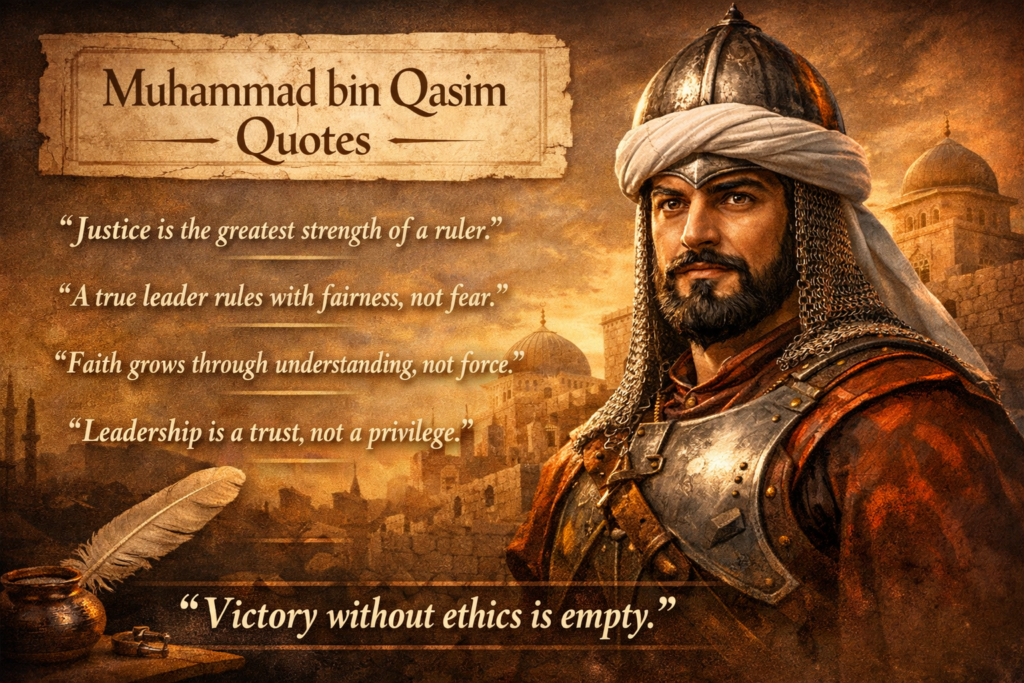
Section 3: Religious Tolerance and Human Rights
Muhammad bin Qasim respected people of different religions. He protected their places of worship and honored agreements with local communities. His actions showed that Islam supports peaceful coexistence.
Attributed Quotes (21–30):
21. Faith cannot be forced.
22. Religious freedom brings peace.
23. Belief must come from the heart.
24. Differences deserve respect.
25. Peaceful living strengthens society.
26. Respect creates unity.
27. Freedom of belief is essential.
28. Tolerance shows strong leadership.
29. Justice applies to everyone.
30. Harmony brings stability.
Section 4: Leadership with Accountability
Muhammad bin Qasim believed leadership was a responsibility, not a personal benefit. He ruled with honesty and transparency. Every decision was made with accountability in mind.
Attributed Quotes (31–40):
31. Leadership is a trust.
32. Power must be accountable.
33. Avoiding responsibility shows weakness.
34. Accountability protects integrity.
35. True leaders stay humble.
36. Every decision has consequences.
37. Transparency builds confidence.
38. No accountability leads to oppression.
39. Rank comes with duty.
40. Answerability keeps justice alive.
Section 5: Ethical Conduct in Warfare
Although Muhammad bin Qasim was a skilled military leader, he followed strict moral rules. He protected civilians and encouraged discipline among soldiers. For him, victory without ethics had no value.
Attributed Quotes (41–50):
41. Victory without morals is empty.
42. Discipline wins battles.
43. Civilians must be protected.
44. Honor controls power.
45. Ethics guide real strength.
46. War does not excuse injustice.
47. Self-control shows true power.
48. Force must support justice.
49. Moral armies bring peace.
50. Honor lasts longer than conquest.
Section 6: Lessons for Today’s Leaders
The leadership style of Muhammad bin Qasim is still relevant today. His focus on justice, tolerance, and integrity applies to modern governments and organizations. Ethical leadership never becomes outdated.
Attributed Quotes (51–60):
51. Values never lose importance.
52. Ethical leadership lasts.
53. Justice fits every time.
54. Morals strengthen authority.
55. Values shape history.
56. Integrity defines success.
57. Strong leadership is value-based.
58. Character builds influence.
59. Ethics outlive power.
60. Leadership starts within.
Section 7: A Legacy Beyond Conquest
Muhammad bin Qasim is remembered not just for expansion but for reform. He left behind systems based on justice and fairness. His legacy is defined by values, not territory.
Attributed Quotes (61–70):
61. Legacy comes from justice.
62. History remembers fairness.
63. Values outlast victories.
64. Real impact is reform.
65. Justice shapes memory.
66. Actions define remembrance.
67. Ethics create legacy.
68. Principled leaders are honored.
69. Integrity builds influence.
70. Justice makes history eternal.
Section 8: Moral Courage and Strong Character
Muhammad bin Qasim showed courage by standing firm on his principles. He did not compromise justice under pressure. His strength came from his character.
Attributed Quotes (71–80):
71. Courage begins with honesty.
72. Justice needs strength.
73. Principles require sacrifice.
74. Standing against wrong is courage.
75. Character gives endurance.
76. Integrity removes fear.
77. Moral strength beats force.
78. Values guide hard choices.
79. Ethics create courage.
80. Rightfulness defines bravery.
Conclusion: A Leader for All Times
Muhammad bin Qasim remains a powerful example of ethical leadership. He balanced authority with justice, faith with tolerance, and power with responsibility. His life continues to guide leaders and societies around the world.
Frequently Asked Questions (FAQs)
Who was Muhammad bin Qasim?
He was a Muslim general and ruler known for justice, tolerance, and ethical leadership.
Are these quotes exact historical quotes?
No, they are attributed and paraphrased to reflect historical values, not exact wording.
Why is Muhammad bin Qasim called a just ruler?
Because he applied equal laws, protected religious freedom, and ruled with accountability.
What can modern leaders learn from him?
Leaders can learn fairness, tolerance, integrity, and responsibility.
Why is Muhammad bin Qasim still important today?
His leadership matches modern values like human rights, justice, and peaceful coexistence.